
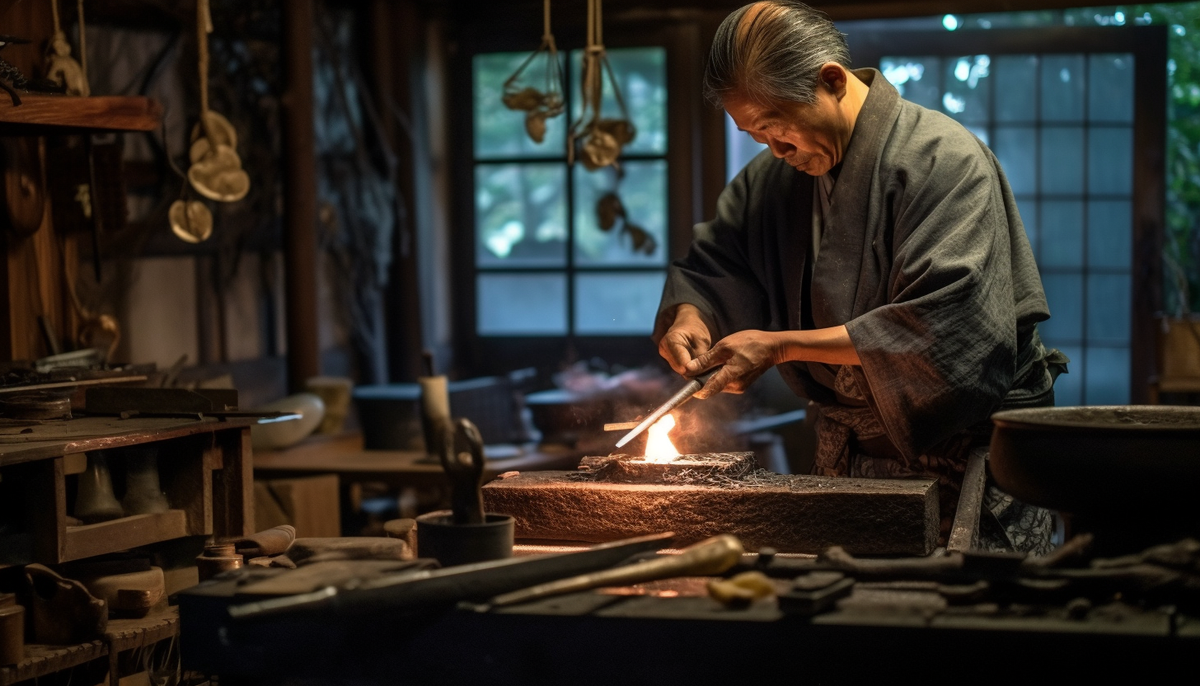
The katana is as much a work of art as a sword. Making one takes great skill and painstaking attention to detail. A crucial part of that process is the choice of materials. In this article we look in detail at the materials used to make katanas.
Steel: the heart of the katana
The most important element in making a katana is the steel. But not just any steel. Katana swordsmiths use a type of steel called tamahagane. Tamahagane is a high-carbon steel made from iron sand in a tatara furnace.
Making tamahagane is a complex process that demands great expertise. The iron sand is heated in the tatara furnace for several days, which allows the iron to separate from other elements and combine with carbon to form steel. The result is a raw block of steel containing pieces of different qualities.
Choosing the steel
Once the raw block of steel is ready, the swordsmith has to choose the pieces of steel he will use to make the katana. This selection is crucial, because it determines the characteristics of the blade.
In general, the swordsmith uses a mixture of high-carbon and low-carbon steel. High-carbon steel is hard and takes a keen edge, but it is also more brittle. Low-carbon steel, on the other hand, is softer and tougher, but it does not take as sharp an edge. By combining the two types of steel, the swordsmith can create a blade that is both sharp and resilient.
Forging the blade
Once the swordsmith has chosen his steel, he begins to forge the blade. This stage involves heating the steel in a forge and then hammering it into shape. The swordsmith also has to fold the steel over on itself several times, which strengthens the blade and creates the distinctive hardening pattern known as the hamon.
Hardening the blade
After forging the blade, the swordsmith moves on to hardening it. This stage is crucial in giving the katana its unique characteristics. The swordsmith coats the blade in a layer of clay, leaving a thin line along the cutting edge exposed. The blade is then heated and quenched rapidly. This differential hardening produces a blade with a hard edge and a softer spine, allowing the katana to be both sharp and resilient.
Polishing the blade
Once the blade has been forged and hardened, it must be polished. This stage is essential to reveal the beauty of the blade and to refine the edge. Polishing a katana is an art in itself and requires great skill. The polisher uses a series of progressively finer stones to refine the blade, a process that can take several weeks.
The handle and the guard
The handle and guard of a katana are also important and call for specific materials. The handle is generally made of wood, covered in ray skin and then wrapped in silk. The ray skin gives the handle a rough texture that helps prevent slipping, while the silk provides a comfortable grip.
The guard, or tsuba, is generally made of iron or bronze. It is often decorated with intricate designs, which may include scenes from nature, mythological figures or geometric patterns.
The saya: the katana's scabbard
The scabbard, or saya, is generally made of lightweight wood and lacquered to protect it. The saya plays a crucial role in protecting the blade and is often elegantly decorated.
Conclusion
Making a katana is a complex process that requires great expertise and a careful selection of materials. From tamahagane steel to ray skin, each material plays a crucial role in the creation of a katana. By understanding these materials and the making process, we can better appreciate the beauty and artistry of the katana.
Share:
The Role of the Katana in Bushido: The Samurai Code
The Rituals Associated with Katanas