
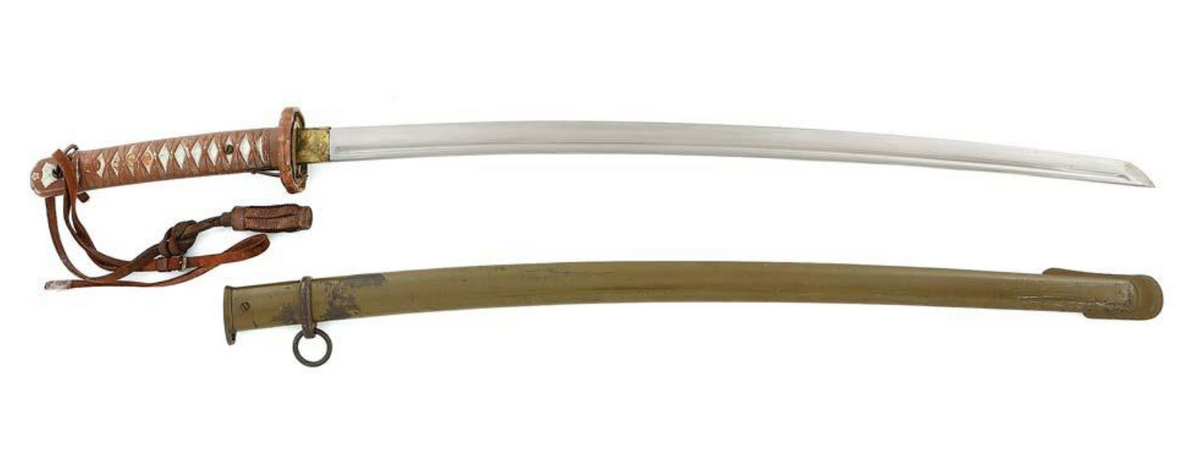
The Gunto, the Japanese military sword, has a rich and fascinating history that spans centuries. A symbol of Japan's military power and an essential element of Japanese martial arts, the history, design and meaning of the Gunto offer a unique perspective on Japan's warrior culture.
In this article we explore the origins of the Gunto, examine its design and craftsmanship in detail, and reflect on its enduring cultural significance.
The Saga of the Gunto
The Roots of the Gunto
Japanese swords go back to the Kofun period (300-538 AD), when the first straight, single-edged swords, called "chokuto", were used. These early swords were strongly influenced by Chinese and Korean sword designs. As Japan's military culture evolved, the curved, single-edged "tachi" became the dominant sword of the samurai class during the Heian period (794-1185 AD).
The samurai, Japan's warrior class, had a profound impact on the development of the Gunto. Samurai culture emphasised martial skill, discipline and honour. The sword was therefore not only a blade but also a symbol of the samurai's status and identity. The "katana", which emerged at the end of the Kamakura period (1185-1333 AD), became the samurai sword par excellence and served as the basis for the development of the Gunto.
The Evolution of the Gunto in Modern Japan
During the Meiji Restoration (1868-1912), Japan rapidly modernised its armed forces, which led to the adoption of Western-style uniforms, equipment and tactics. In 1875, as part of this modernisation effort, the Japanese government introduced the "kyu-gunto", a Western-style military sword. The kyu-gunto combined elements of traditional Japanese sword design with features of the European sabre.
The "shin-gunto", the most emblematic Gunto design, was developed in the 1930s as the Japanese army prepared for the conflict of the 1940s. It was intended to evoke the spirit of the samurai while being easier to mass-produce. Shin-gunto swords had a machine-made blade, a brass hilt of simplified design, and a metal scabbard.
After Japan's defeat in 1945, the occupying Allied forces banned the production and possession of swords, including the Gunto. The ban was lifted in 1953, and since then the Gunto has become a popular collector's item and a symbol of Japanese military history.
The Anatomy of a Gunto
- Blade: The blade of a Gunto is generally made of high-quality steel and is single-edged with a slight curve. The forging process involves folding and hammering the steel several times to create layers, which gives a strong, sharp blade.
- Tang: The tang is the unsharpened part of the blade that extends into the handle. It is fixed to the handle with a wooden peg, which ensures a firm grip.
- Guard: The guard, or "tsuba", is a circular or square piece of metal that separates the blade from the handle. It protects the hand and may carry intricate designs and engravings.
- Handle: The handle, or "tsuka", is wrapped using a traditional Japanese braiding technique called "tsukamaki", using silk or cotton cord for a secure grip. Beneath the wrapping, a wooden core forms the base. The handle may also carry ornaments, such as "menuki" (small metal ornaments) and a "fuchi" (metal collar) at the base.
- Scabbard: The scabbard, or "saya", is a wooden sheath that protects the blade when it is not in use. It may be lacquered and decorated with various designs, often to match the sword's fittings.
The Art of Forging a Gunto
Traditional Methods and Materials
Traditional Gunto blades were forged using a process involving "tamahagane", in which iron sand was smelted in a clay furnace to produce steel. This steel was then folded and hammered repeatedly to create a blade of exceptional strength and sharpness. The process also involved differential heat treatment of the blade, creating a distinctive wavy pattern called the "hamon" along the cutting edge.
Modern Techniques and Innovations
While some modern Gunto swords are still made using traditional methods, many are now produced using more efficient and economical techniques. These include the use of modern alloys and machine-forging processes to create a uniform, consistent product. Even though these swords may lack the subtleties of traditional craftsmanship, they still embody the spirit and aesthetic of the Gunto.
The Aesthetics of the Gunto
- Engraving and decoration: The Gunto often features intricate engravings and decoration on the blade, the guard and the other fittings. These motifs may include traditional Japanese designs, such as cherry blossoms, dragons or family crests, and reflect the identity and values of the owner.
- Symbolism and cultural significance: The Gunto is a symbol of Japan's warrior culture and military history. Its design elements often refer to Japan's legendary past and to the values of honour, loyalty and discipline. The Gunto thus serves as a tangible reminder of the country's martial heritage and of the importance of these values in modern Japanese society.
The Significance of the Gunto
- The Gunto as a Symbol of Japanese Military Tradition
The Gunto represents the culmination of several centuries of mastery of the Japanese sword, combining traditional craftsmanship with modern design elements. As a symbol of Japanese military tradition, the Gunto continues to evoke the spirit of the samurai and the values they upheld.
-
The Role of the Gunto in Martial Arts and Swordsmanship
- Kendo and Iaido: The Gunto plays a significant role in the practice of Japanese martial arts such as Kendo and Iaido. In Kendo, practitioners use bamboo swords or wooden replicas called "bokken" to sharpen their swordsmanship, while Iaido focuses on the art of drawing, cutting and re-sheathing the sword fluidly and precisely.
- Techniques and principles: The techniques and principles of Gunto swordsmanship are rooted in samurai tradition, emphasising fluidity, precision and mental concentration. Practitioners of these martial arts strive to cultivate a deep connection with their sword and an understanding of its role as both a tool and a symbol of honour.
-
The Gunto as a Collector's Item
- Rarity and value: Gunto swords, particularly those with historical significance or made by renowned swordsmiths, are highly sought after by collectors. The rarity, craftsmanship and provenance of a particular Gunto can carry considerable value in the collector's market.
- Preservation and restoration: The preservation and restoration of antique Gunto swords are important aspects of maintaining their historical and cultural significance. Collectors and enthusiasts often invest in professional restoration services to ensure that swords are properly maintained and preserved. This includes cleaning, polishing and repairing any damage to the blade, fittings or scabbard. Proper storage and handling are also essential to preserve the integrity and value of the sword.
The Gunto, with its rich history and intricate design, serves as a symbol of Japan's military tradition and cultural identity. From its origins in the samurai class to its evolution in modern Japan, the Gunto has remained a testament to the values of honour, loyalty and discipline that shaped the country's warrior culture.
>> Browse our hand-forged katanas
Share:
Where to Find the Moonveil Katana in Elden Ring
Samurai and Their Arms: Beyond the Katana