
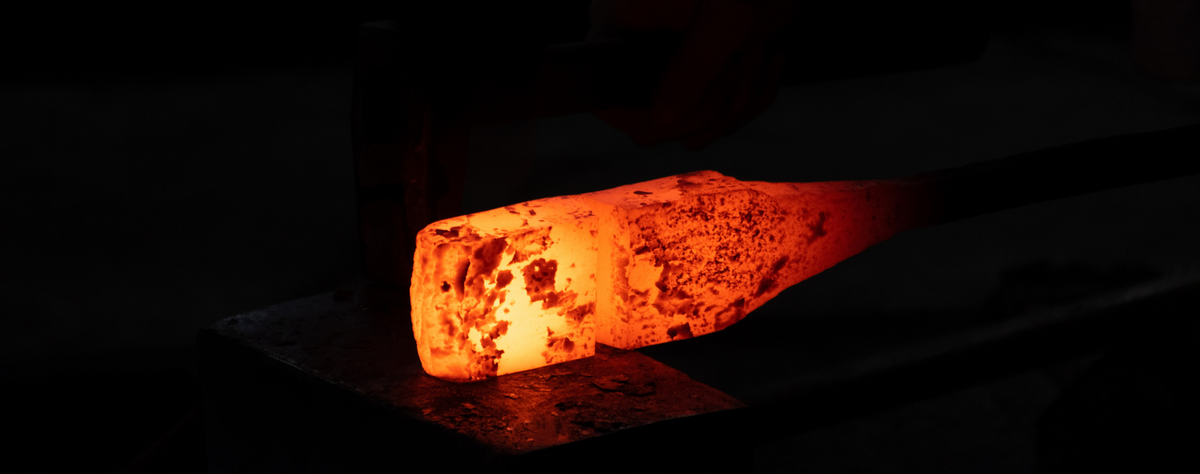
You have probably heard of Japanese swords, such as the katana, made from tamahagane steel. But what exactly is tamahagane steel?
Tamahagane steel: the basics
Tamahagane is a particular, rare type of steel used by traditional Japanese swordsmiths. It is characterised by a higher carbon content, which makes for a stronger blade.
Tamahagane typically contains between 1 and 1.5% carbon. Reaching the correct carbon level is essential: too much makes the blade brittle, and too little means the blade will not hold up. Japanese smiths perfected the art of making tamahagane with a precise concentration of carbon to overcome these obstacles.
How is tamahagane steel made?
In his book "Spirit of the Sword: A Celebration of Artistry and Craftsmanship", author Steve Shackleford explains that the method of making tamahagane differs from that of conventional steel.
The process begins by melting several layers of charcoal and iron sand in a special clay furnace called a tatara. Two types of iron sand are used for this process: akome and masa, the latter being of higher quality. Normally, a person known as the murage is responsible for choosing the iron sand used to make tamahagane.
The smith separates the different types of carbon steel, notably low-carbon steel (hocho-tetsu) and high-carbon steel (tamahagane). The smith then forges the tamahagane in alternating layers. During this process the smith may fold the steel up to 16 times. If the tamahagane is not folded, the uneven distribution of carbon in the metal creates weak points in the sword.
It is important to note that tamahagane is not the only metal used to forge traditional Japanese swords. Swordsmiths often use several types of material produced in the tatara. Hocho-tetsu, for example, is used to forge the core structure of the blade, while high-carbon tamahagane is combined with pig iron to make the outer layer of the blade.
You can usually recognise a high-quality tamahagane blade by looking for its characteristic bright silver/chrome colour.
Today, the production of tamahagane is tightly regulated by the Japanese government. It is currently illegal to export raw tamahagane before it has been turned into a finished product ready for sale.
In addition, it is generally produced only 3 to 4 times a year, which makes this metal exceptionally rare and drives up costs for consumers.
Note: most tamahagane katanas sold by Chinese sword makers and their distributors are not genuine tamahagane, but unregulated Chinese imitations whose quality-control process is unknown.
Share:
Kodachi vs Wakizashi: What Is the Difference?
Dao vs Jian: What Is the Difference?