
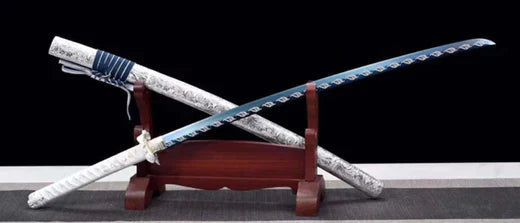
From the Chinese Dadao and Liuyedao to the Nepalese Kukri, the Indian Talwar, the Persian Shamshir, the Turkish Kilij and the Greek Kopis, curved swords are among the most elegant bladed arms of antiquity. However, no other sword is as culturally rich and mystically beautiful as the Japanese katana.
For centuries, the katana has been admired worldwide, its elegant curve complementing the many refined details of every sword. That is still true today.
But why are katanas curved? Did the traditional Japanese swordsmiths plan for the katana to look this distinctive? Does the curve offer advantages over a straight-backed sword?
Join us as we uncover the secrets of the katana's curve and answer other questions you may have about this legendary Japanese sword.
The real reason for the katana's curve
Many people believe that the traditional swordsmiths of the Heian period deliberately forged Japanese swords with a slight curve. According to them, this change in sword-making philosophy reflected the changing landscape of feudal conflict, in which more and more samurai rode to battle on horseback.
While that may be true, the "curve" of the sword blade was not wanted or intentional. It can be described as the "unexpected" result of a revolutionary method of making stronger, faster and more precise swords.
The Japanese sword that came before the katana was the Chokuto, whose blade had a straight edge. Early Japanese warriors used the Chokuto between the 6th and 8th centuries, mainly in the Tohoku region of ancient Japan. There was also the Tsurugi, a straight, double-edged sword similar to most Western bladed arms.
The first katana
Around 700 AD, the swordsmith Amakuni used a unique "folded steel forging" technique borrowed from China, producing Japan's first single-edged curved sword, the Tachi.
Over the decades, the Tachi came in short and standard versions, the latter being called Uchigatana. While the Japanese called the short Tachi Uchigatana, the rest of the world called it "katana".
Curving the katana
Before the Tachi, Japanese swords had a straight edge. Amakuni's blade-forging technique made it possible to create a curved sword, albeit inadvertently. How?
The Tachi or katana had a straight edge, but only up to a certain stage in the sword-making process.
Katana swordsmiths coat the length of the blade with special clay during the hardening process, aptly called "clay hardening". The cutting edge of the blade (Ha) is covered with a thinner layer of clay than the Mune, or spine. Heating and quenching the clay-coated blade results in a difference in temperature.
The Ha, covered with a thin layer of clay, cools faster than the Mune, covered with a thick layer of clay, which allows the Ha to harden (due to the formation of martensite crystals). Meanwhile, the Mune remains "soft and supple" (due to the formation of ferrite and pearlite).
Katana swordsmiths repeat this cycle of heating, quenching and hammering several hundred times. The resulting contraction and expansion cause the katana to bend towards its back, forming the now-iconic curve of the katana (Sori).
Why are katanas curved? The characteristic curve of these legendary Japanese swords is due to differences in temperature during the multi-fold forging process, in particular the clay hardening.

The advantages of a curved katana
We know that Amakuni and the generations of katana swordsmiths who followed him did not intend to bend or curve the sword. But it happened anyway. So are there advantages to the curved katana that we do not know about?
Easier drawing of the sword
Some say that a straight-bladed sword is as easy to draw as a curved blade, often depending on the wielder's skill in handling the sword. It is a shame that we no longer have medieval samurai who could enlighten us with first-hand knowledge on this question.
Nevertheless, master Iaidoka (practitioners of Iaido) attest to the remarkable ease with which a katana can be drawn.
Drawing a curved katana from its Saya follows the natural, arc-shaped path of the human arm. This makes for a quick, fluid movement, eliminating unnecessary motion and ensuring a faster cut.
Improved cutting ability
The martial art of Iaido teaches students the techniques of the legendary samurai sword, including drawing and cutting a target in a single fluid movement.
Legend has it that a highly skilled samurai could defeat an opponent with a single stroke, before the opponent even noticed.
Although the curve of the katana makes it possible to cut a target with speed and precision, experts say that the katana's cutting prowess depends more on its Bohi, or groove.
This recess below the Mune allows the katana to shed some of its weight without compromising its durability and cutting abilities. It also produces an exceptional Tachi Kaze, the distinctive whirling sound heard when we swing the katana. The sound feedback lets users judge the angle of the katana, enabling them to make more precise cuts.
While the Bohi influences the katana's cutting abilities, the curve of the blade matters too. The curved blade slices through targets, rather than piercing or biting into them. It does not become lodged in the target, which allows the swordsman to rotate the katana for another cut.
Better control and balance
As mentioned, the Bohi in the curved blade of the katana makes the sword 20 to 30 times lighter than conventional Japanese swords without a Bohi. The curve also shifts the blade's centre of balance slightly further forward, which improves the control and precision of the sword.
A word on Sori
Although the blade of the katana is curved, its curvature (Sori) varies from one swordsmith to another.
Controlling the expansion and contraction of the steel to give the katana its characteristic curve is not an exact science, particularly among traditional Japanese swordsmiths. They often rely on decades of training and katana making to achieve the katana's iconic curve.
However, most swords have a curvature of 1.5 centimetres, or about 0.6 inch, measured from an imaginary line between the Habaki (collar) and the Kissaki (point).
Interestingly, the katana's predecessor, the Tachi, has a Sori of 2.7 centimetres (1.1 in), making it more curved than the katana.
This is not surprising, given that the blade of the Tachi measures 70 to 80 centimetres, or about 27.6 to 31.5 inches. By contrast, the blade of the katana measures only 60 to 80 centimetres (23.62 to 31.5 inches).

The bottom line
Why are katanas curved? The curve of the katana is not a deliberate attribute, but the consequence of a unique forging process that curves the blade a few centimetres from the spine. It gives the katana one of its most iconic attributes, while also allowing those who wield it to improve their swordsmanship. To learn more about katanas, click here.
Share:
Real vs Fake Katana: How to Tell the Difference
Zoro's Swords in One Piece: What You Need to Know