
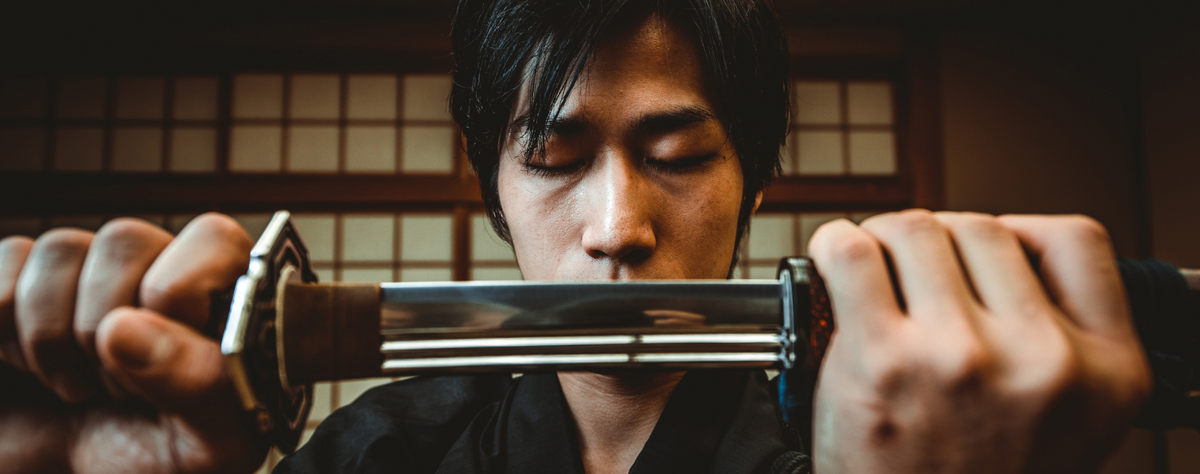
The term "Japanese sword" refers to steel swords made in Japan. There are many types of Japanese sword, and their forms evolved over time along with changing military practice. They include the "straight sword", the "tachi", the "uchigatana", the wakizashi and the "tanto". What follows is an introduction to the 10 types of Japanese sword.
Straight sword
The term "straight sword" refers to swords of the kiriha-zukuri style, which were used before the middle of the Heian period and had no shinogi (ridge line). Bronze and iron tools were introduced to Japan from the continent during the Yayoi period. Ironmaking technology then developed in the country and iron forging began. There are many opinions on the date, but the currently accepted theory is that it dates from the end of the Kofun period.
Since most of the straight swords made at the time have been excavated, it is not possible to determine a precise date of production, as many of them are rusted or have lost their original shape. However, although the blade is fragile, the accompanying koshirae (sword mounting) has been found in an almost original state.
It is therefore possible to guess, from the materials and decoration, what type of sword it was. Swords with magnificent mountings are said not to have been used in practice, but mainly for ceremonial purposes, as gifts, as offerings or as presents for powerful people.
There are also several types of straight sword. At first the blade was plain, but gradually the "kantou no tachi" (large ring-pommel swords) were made, with gold and silver decoration on the handle and the mountings.
Tachi
The "tachi" is a curved sword of the shinogi style that appeared at the end of the Heian period (794-1185).
It is curved like a bow, with a "koshi-zori" shape, in which the blade near the tang (nakago: the tang of the blade) is strongly curved.
It measured more than 2 shaku (about 60 cm) in length and was worn at the waist, suspended from a cord, with the edge pointing downwards. This is called "佩く" (haku) or "佩用する" (haiyou).
It was only in the early Heian period (794-1185) that the "wanto" (sword), said to be the prototype of the tachi, began to be made.
The wanto later became the tachi (sword) and was used until the Nanbokucho period, when mounted campaigns were the norm, because it was better suited to cutting than a straight sword.
Types of sword
Tachi can be divided into three types according to their size: the "large tachi" (大太刀), the tachi (太刀) and the "small tachi" (小太刀).
Nodachi
Large swords, also called "nodachi" (nodachi/notachi), are big swords with a blade of more than 3 shaku (about 90 cm). Originally designed as swords intended to be dedicated to shrines, they are said to have sometimes been used on the battlefield.
Only high-ranking samurai were allowed to own large swords. However, as they were not easy to carry, they were carried by retainers on the battlefield. When one was used, the sword was either sheathed and carried by the follower, or drawn from its scabbard by the follower and handed over.
Surviving notachi include the Shida Otachi, owned by the Yahiko Shrine (Nishikanbara District, Niigata Prefecture), and the Nenekirimaru, owned by the Nikko Futaarayama Shrine (Nikko City, Tochigi Prefecture). Both swords are designated Important Cultural Properties.

Kodachi
The kodachi is a sword with a blade length of less than 2 shaku (about 60 cm) that has been made since the middle of the Kamakura period. It was never used in actual battles and was used mainly at ceremonies and celebrations. As its size is similar to that of the "wakizashi" seen at the end of the Sengoku period, the two are sometimes equated, but it is classed as a tachi-type sword because of its shape and curvature.
Uchigatana
An "uchigatana" is a sword generally called a "Japanese sword". The blade length is 2 shaku (about 60 cm) or more, and the blade is characterised by a shallow curvature. As for how it is carried, the blade is turned downwards, but the sword is generally placed at the waist.
From the middle of the Heian period to the middle of the Muromachi period, swords were used on horseback, so swords that were convenient for swinging downwards were useful. In the Sengoku period, the end of the Muromachi period, the nature of military campaigns changed from individual mounted engagements to group engagements on foot. In response to the trend of the time, swords suited to such engagements (kachi-ikusa: infantry engagements) became mainstream.
The sword used earlier was adapted by a modification called "shortening (suriage)", which cuts the tang down. If a sword is shortened, the inscription (the swordsmith's name and the age of the sword, cut into the tang), which is the most informative evidence for understanding the sword, is lost, but from characteristics such as the form of the sword and the ground steel (jigane), the maker and the age of the sword can still be guessed.
Wakizashi

The wakizashi is a Japanese sword with a blade length equal to or greater than 1 shaku (about 30 cm) and less than 2 shaku (about 60 cm). The wakizashi appeared after the Muromachi period and was used as a complement to the tachi and uchigatana. There are several theories, but the name comes from "because I put it at the side of my waist".
Like a long sword, it is thrust into the obi with the edge facing upwards, but as it is shorter than a long sword, it is said to have been used at close quarters and in confined spaces. It was also used as a spare sword when the main sword was broken or chipped.
It can be classified into three types, "Owakizashi", "Nakawakizashi" and "Kowakizashi", according to its length.
- Owakizashi: length from 1 shaku 8 sun (about 54.5 cm) to less than 2 shaku (about 60.6 cm).
- Nakawakizashi: length from 1 shaku 3 sun (about 40 cm) to less than 1 shaku 8 sun (about 54.5 cm).
- Kowakizashi: length of less than 1 shaku 3 sun (about 40 cm).
In historical dramas set in the Edo period, a Japanese sword set of "the large and small swords" is used, but this style is said to have originated towards the end of the Muromachi period.
The large sword is the long sword, and the small sword is the wakizashi.
And since non-samurai townspeople were only allowed to own wakizashi, many wakizashi were made during this period.
Tanto
A "tanto" is a Japanese sword with a blade length of 1 shaku (about 30 cm) or less. It was also called "Koshigatana" because the samurai wore it at the waist with the edge facing upwards. From the Kamakura period to the Muromachi period it was used at close quarters on the battlefield, but by the Momoyama period it was no longer used there.
After the Edo period, a samurai's daughter owned a dagger of her own. It was called "Kaiken" because there were many occasions on which it was tucked into the front of the kimono.
A dagger is sometimes confused with a wakizashi because of its size, but one with a guard may be a wakizashi, whereas one without a guard may be an "aikuchi". It can be distinguished from a dirk.
Naginata
The "Naginata" is a long-handled bladed polearm specialised in slashing. Born in the Heian period, it played a leading role in many battles during the Northern and Southern Courts period. It was originally written "long sword", but it is said that the naginata character was applied later to distinguish it, because the uchigatana was called the long sword as opposed to the dagger.
The length and shape of the naginata differ from one era to another. In the Kamakura period, the length of the shaft was about 4 shaku (about 120 cm) and the length of the blade was about 3 shaku (about 90 cm). ... On the other hand, the naginata called the "Osanagi sword" that appeared in the Nanbokucho period evolved towards a longer blade and shaft.
According to records, there was a naginata with a shaft length of about 5 shaku (about 150 cm) and a blade length of 6 shaku 3 sun (about 190 cm). The naginata was popular as the principal arm of the Northern and Southern Courts period, but in the Sengoku period, when the format of engagements changed to group formations, accidents occurred in which allies were cut by mistake.
As a result, the "spear" (lance) took the naginata's place. The naginata gradually declined because the spear, a similar long-handled implement, was used in the field instead. After that, it was remade into a wakizashi called a "naginata-naoshi", a large form of the blade, which ended its career as a long-handled polearm.
Nagamaki
The "nagamaki" is a sword very similar to the naginata, and in fact there is no clear definition.
It is said to have originally been developed to make the Ōdachi easier to handle, and the differences are generally "the difference in size", "the degree of curvature", "the presence or absence of a yokote", and "the mountings", and so on.
Differences in size
The general blade length of the naginata is about 2 shaku (about 60 cm), and the length of the shaft is about 9 shaku (about 270 cm). The blade length of the nagamaki, on the other hand, is about 3 shaku (about 90 cm), and the shaft length is about 3 shaku (about 90 cm) to about 4 shaku (about 120 cm), so the blade and the shaft are almost the same length.
With or without a yokote
The "yokote" is the dividing line that runs across the lower part of the sword tip.
It is usually a feature found in Japanese swords, but the naginata has no yokote.
The nagamaki, however, does have a yokote.
Share:
What Is the Naginata?
Japanese Sword Polishing: The Complete Guide