
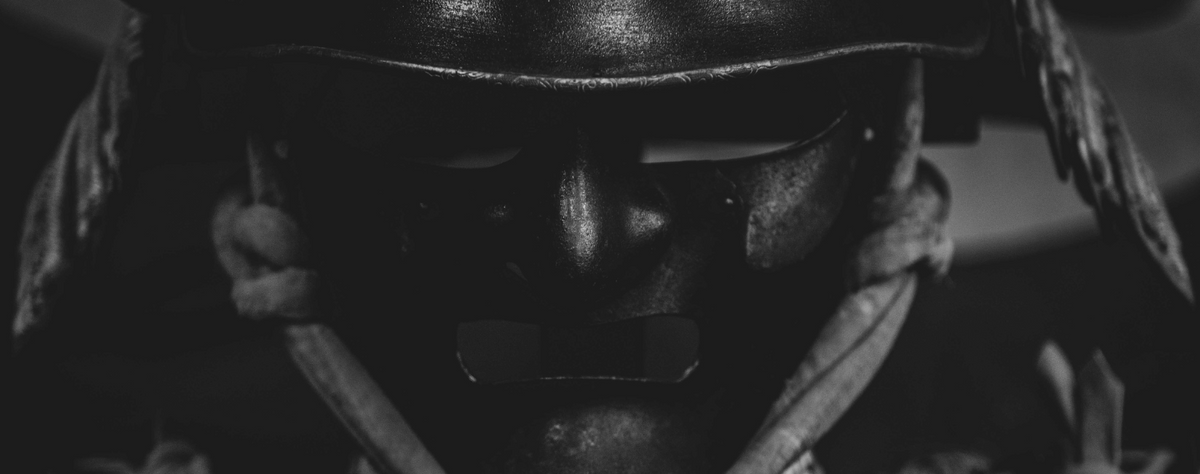
Definition of the men-yoroi
The men-yoroi is a piece of protective equipment attached to a samurai's armour to protect the face. It is said to have first appeared at the end of the Heian period (794–1185). It later became very popular from the end of the Muromachi period (1333–1573) to the Azuchi-Momoyama period (1573–1584).
During this time the "tosei-gusoku", a type of armour that was both mobile and strong, appeared. Like the tosei-gusoku, which were made for the feudal lords of the Sengoku period, a variety of men-yoroi were also produced.
Here we explain the basics of the men-yoroi.
Men-yoroi: an overview
Although its use spread from the end of the Muromachi period (1333–1573) to the Azuchi-Momoyama period (1573–1584), it has a surprisingly long history, and masks of the "happuri" type are thought to have been used as early as the end of the Heian period (794–1185). However, it was only from the Nanbokucho period (1336–1392) that the distinctive development of the men-yoroi began. These types of armour are said to be linked to the masks used in sarugaku (Noh theatre), which was created in the Muromachi period (1336–1573).
A feature of this armour, such as the "cheek guards below the eyes" and the "full masks" that cover most of the face except the eyes, is that they carry rich facial expressions of their own.
This armour also served as a "mask" on the battlefield, since the wearer could rouse his spirit by displaying a heroic expression, or confuse the enemy by showing a laughing face, which was out of place on the battlefield.
Types of men-yoroi
There are five main types of men-yoroi:
- the happuri (protects the forehead and cheeks)
- the hanbō (protects the area from below the nose to the chin)
- the menpō (protects the nose down to below the chin)
- the mengu (protects the cheeks)
- the somen (full face protection)
Happuri
The happuri has the longest history. It is thought to have appeared at the end of the Heian period (794–1185) and is mentioned in the "Hogen Monogatari" (Tale of Hogen), which describes the events of the Hogen Rebellion, and in the "Taiheiki", a military chronicle of the Nanbokucho period (1336–1392).
Although it declined after the Muromachi period (1333–1573), reproductions became popular during the Edo period (1603–1867), when nostalgia for the past was on the rise.
Most were made of iron, and some happuri are said to have been made of leather with the surface covered in lacquer.
Some picture scrolls also show happuri made of "egawa" (deerskin with a pattern painted by stencil dyeing), which suggests that various decorations were added.
Hanbō
The hanbō is a mask covering both cheeks and the chin. It has no nose. It protects the throat area. The traditional hanbō was attached to the nodowa, a small piece of armour covering the gap between the throat and the upper breastplate.
Types of hanbō include the "sarubō", the "tsubakurobō" and the "kaga hanbō". Some types of hanbō were made in the shape of a mouth, while others were made without a mouth.
The kaga hanbō are generally the smallest of the hanbō and are also called "chin-atsu", as they were formed to protect only the chin.
Me no shita bō (cheek guard below the eyes)
The cheek guard below the eyes is the cheek guard that comes with a nose. The difference between the half cheek guard mentioned above and the cheek guard below the eyes is the presence or absence of the nose.
The oldest surviving cheek guard below the eyes was made in the early Muromachi period. Its most significant feature is its expressive face.
As these pieces were worn on the battlefield, most are "ketsusei-men", which have a vigorous, angry expression. The material used for these masks was mainly iron, and leather was also often used.
Most were made of iron, but some were made of leather. Some noses are detachable, while others are attached as they are, and some have ears while others do not. A beard was planted around the mouth to express martial dignity.
The reason for the open mouth on the cheek guards below the eyes was to make breathing and speaking easier on the battlefield. In addition, by removing the area above the eyes, the weight of the piece was reduced.
Mengu (cheek guards) are increasingly popular as works of art, as they were produced using advanced engraving techniques, but we can also see that the practical function of these cheek guards (kogusoku) was emphasised as well.
Somen
There are two types of somen: one with a nose and one without.
Covering the wearer without any gap, this armour can be said to be highly protective.
However, when worn in the field, the somen were heavier than necessary and reduced visibility, which made their usefulness questionable. For this reason, the masks are said not to have become widespread.
During the Edo period (1603–1867), when the country entered a period of peace and tranquillity, armourers competed in technique to produce highly decorative full masks by hammering the iron or adding modifications to the wrinkles. They became popular not as armour but as works of art.
Share:
The Samurai Armour Guide
Who Was Date Masamune?