
Are you an enthusiast, a collector or simply curious about samurai armour? This article will give you the historical basics of samurai armour and the main parts of a suit of samurai armour, and finally we will offer some advice if you would like to obtain one.
Samurai armour: a powerful symbol
For many centuries, samurai warriors fought for land and power across the islands of Japan, in the name of the daimyo, the shogun or the emperor. During this period, samurai warriors developed a culture and a way of life whose teachings are still visible in modern Japan today.
Internationally, however, the image of the samurai is not so much perceived through the teachings of the bushido code (the way of the warrior) but symbolised, perhaps more than any other warrior in history, by the armour he wore. Samurai armour is made in such a complex and unique way that it can tell the story of these warriors in the finest detail, making these ancient pieces a true glimpse into Japan's turbulent history.
What is samurai armour?

Samurai armour is a piece of steel armour that covers the body of the samurai. It changed over the centuries in response to the different types of arms introduced into Japan. Early armour was relatively light and often built so that the wearer could move quickly.
Over time, however, the arms of enemies evolved. This is why samurai armour became heavier and thicker, which made it slower but also more resistant to sword and arrow attacks.
Until the 19th century in Japan, samurai armour was still used in battles between opposing forces. This practice ended when firearms replaced bows and arrows as the main arms of the battlefield.
Samurai armour has many variations and additions. The pieces that made up a samurai's protection on the battlefield were all complex and specifically made, both for the symbolism and image they projected and for the protection they could offer.
In this respect, a samurai's armour, from head to toe, was unique to that warrior and told, in many ways, his story and that of the clan he served.
Traditional armour includes the kabuto (helmet), the dou (main torso armour), the kusazuri (leg armour), the kote and the kogake for the arms and, finally, perhaps the most iconic piece of all, the katana sword. During the centuries of civil conflict that set Japan ablaze, samurai of the different clans modified and changed their armour. This included adding certain pieces such as the menpo (chin guard).
Main parts of samurai armour

1. Samurai helmet (kabuto)
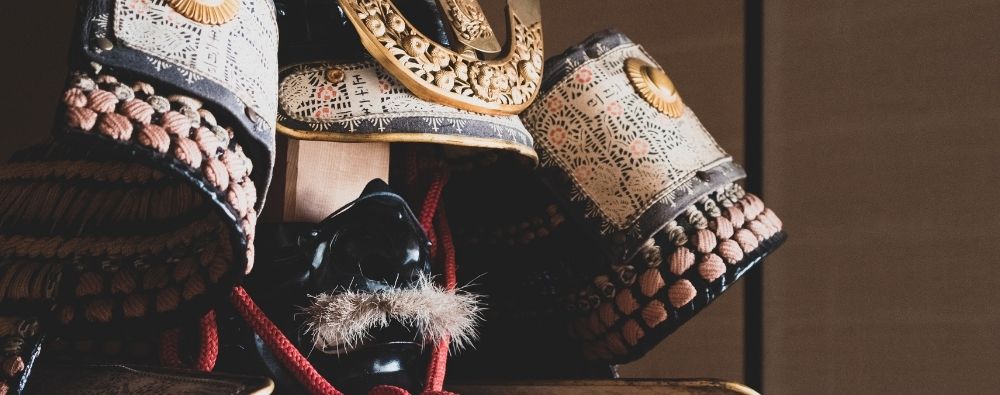
The most distinctive and recognisable piece of samurai armour is arguably the helmet, or kabuto. The unique design of the Japanese warrior's helmet makes it instantly recognisable as that of a samurai and symbolises the complexity of the skills and craftsmanship required to design each suit of armour.
Early in Japanese history, these helmets were generally made of leather; later, they evolved to iron with leather padding and even iron scales in order to deflect arrows or katana blows. A samurai's helmet was often topped with a crest to show his allegiance and which lord he served.
As in other cultures, the kabuto helmet was an incredibly important part of the samurai's armour, both physically and spiritually. There is, in fact, an old Japanese saying, "Katte kabuto no o wo shimeyo", which means "tighten the cords of your kabuto in victory" (roughly equivalent to "do not rest on your laurels"). Likewise, the symbolic act of removing a kabuto meant surrender.
Kabuto helmets often came with the addition of a menpo, a chin guard that could be fixed by two hooks on the side of the kabuto helmet. Originally, menpo chin guards were little more than chin straps but, as the design of samurai armour became more and more sophisticated, menpo began to have their own designs, notably those that covered the whole mouth and were carved into particularly fearsome facial features.
2. Torso armour (dou or dō)
The torso armour was one of the bulkiest items a samurai could wear. The cuirass differed from its European counterparts in that it was designed principally for mobility, and to protect the samurai's torso on the battlefield without hindering his movements. Whereas the knights of Europe preferred thicker, heavier metal plates for protection, the samurai's cuirass or breastplate was often made (like the kabuto helmet) of leather, and later of iron scales or plates. The scale effect gave the armour durability while creating a resistance that protected against heavy blows.
The armour was also often covered with a lacquered finish to make it weatherproof and to prevent damage or weakening when exposed to the elements.
3. The "skirt" armour (kusazuri)
The kusazuri is another piece of armour unique to Japanese warriors. This section, made of chain mail, is designed to protect the thighs and upper legs, and gives the appearance of a skirt worn under the dou. This part of the samurai's equipment was an ingenious way of protecting a rider's legs from blows when he rode his horse into battle.
4. Samurai arm armour (kote)
Samurai feet and hands had individual protection specially designed and made for the purpose. The main function was to allow the samurai to be light on his feet while protecting them from injury and, for his hands, to be able to handle his katana effectively while having the means to guard against another warrior's counter-attack.
The arm guards were cylindrical tubes of fabric that were then reinforced with chain mail and armour plates for added strength. They protected the samurai from the elbow to the finger. Originally, during the Kamakura period, samurai used this armour to cover only one of their arms so that they could shoot arrows from their bows effectively. This changed, however, when the katana gradually became the samurai's preferred sword.
5. Samurai arrowheads
Although the traditional image of the samurai is that of a warrior armed with a sword, archery also played a key role in the rivalry between enemies throughout Japanese history. The art of kyudo became one of the key principles of the samurai for instilling concentration and discipline. The Yabusame were samurai archers who often played a decisive role in the tactics of military commanders and, although the arrival of firearms led to a decline in the effectiveness of archers on the battlefield, the samurai tradition of archery is still celebrated today with performances at the annual Aoi Matsuri.
6. The samurai katana

The last part of a samurai's armour is perhaps the most important of all. The katana is considered not only a symbol of the samurai warrior but also a symbol of Japan as a whole. The official use of the Japanese katana by soldiers began in the Kamakura era (1185-1333) and its popularity as a sword of the battlefield grew steadily (although the use of katanas is documented much earlier in Japanese history).
By the end of the Kamakura era, an entire industry had developed around the creation of the katana. Rival swordsmiths competed for the reputation of making the best katanas, and the quality and design of many of these creations kept improving.
The katana was regarded as such an important sword of the battlefield that an entire system of training (kendo) was devised to teach samurai how to use it. The 15th century saw the start of mass production of the katana. Many foot soldiers in the various armies were equipped with katanas of low quality and simple design.
However, the invention of steel led to a renewed rise in the popularity of the sword. More and more, samurai of the nobility sought to have their katanas made to measure, which gave rise to some of the most complex and unique designs. Even today, an antique katana can often be linked to the samurai who owned it and the battles in which it took part.
For many countries, the arms and armour used by their warriors throughout history are proud relics of the country's past. However, there is no other country where the image of a suit of armour so immediately evokes the image of a nation as samurai armour does for Japan. In all its subtleties, its attention to detail and its functional parts, samurai armour truly tells the story of a nation like no other.
Why is collecting samurai armour so fascinating?

Almost every samurai worthy of the name had a taste for collecting katanas, but armour was an even more popular item among the warrior classes. From the 12th century, armour was made from various materials, including leather, silk, paper and lacquer.
A collection of samurai armour is fascinating because it is a window onto the life of an elite class of warriors in feudal Japan. The quality and craftsmanship of these costumes were often exquisitely fine, and they were worn by samurai on special occasions or on the battlefield.
Buying samurai armour in the right size
Wearing armour for the first time can be a daunting task. It is important to get the right size to avoid discomfort or pinching. When you buy samurai armour, it is important to know your measurements before buying anything online. This will save you from having to send items back because they do not fit properly once delivered to your home.
How can collectors display their samurai armour collection?
Collectors often want to present their collection in a way that is respectful and does not take up too much space.
One of the most popular ways to display your collection is to use a display case or collector's stand. There are many types of cases and display stands for sale, so the first step is to find the one that best meets your needs.
The next step is to find a room where you can set up your displays, but if you do not have room for this, there are other options, such as displaying them on shelves or even grouping them with other samurai objects in a home or office.
How is samurai armour worn?

The most widespread misconception about samurai armour is that it is simply a metal costume, but in reality it is far more complex than that. Samurai armour has many different pieces and it takes years to learn how to put them together properly.
Although feudal Japan disappeared centuries ago, there are still many people who make their own samurai armour for fun or for competitions such as the World Cosplay Summit.
How do you clean and store samurai armour properly?
Samurai armour was a sign of status and a way of displaying wealth. It protected against attacks, but also against disease.
By cleaning and storing your samurai armour properly, you will be able to keep its appearance for years. To clean it, you can use a sponge or damp cloth that has been soaked in distilled water. Do not use soap, as this could damage the metal surfaces of your samurai armour. After removing the dirt and grime, rinse the armour with clean water and let it dry completely before storing it.
The key is to store and care for your samurai armour properly so that it can last for centuries!
Share:
What Is Japanese Samurai Armour?
What Is a Men-Yoroi? Samurai Face Armour Explained