
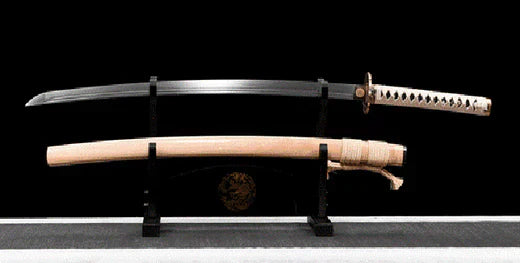
Japanese swords are among the most iconic bladed objects in the world. From the curved tachi to the legendary katana, these swords are not only formidable instruments but also fascinating works of art.
Unfortunately, the disappearance of the samurai in the Meiji era led to the decline of these swords in favour of the rifle. During the Second World War, however, Japanese military officers carried swords. What happened? Join us as we explore the resurgence of the Japanese sword, including the Japanese sword used during the Second World War.
Understanding the Japanese swords of the Second World War
To appreciate the Japanese swords of the Second World War, we first need to get to know the history. We begin with the Meiji period.
This period of Japanese history marks the continuation of the nation's social, political and economic reforms. It opened Japan to Western customs and technology, allowing the country to move from the feudal system to modernity.
According to historians, the Meiji era laid the foundations for Japan's rise on the international stage as a major power.
The reforms required the Japanese to abandon old ways and adopt new ones, including setting aside the sword as the foremost symbol of the warrior. The Haitōrei edict banned the wearing and display of swords (katana in particular) in public. It was a bitter pill that many Japanese found hard to swallow.

The Meiji period of restoration, reform and modernisation in Japan. Photo from the Japan Times.
Although Japan's march into the modern era brought a revision of its military capabilities, some senior officers drew inspiration from ancestral traditions. While the katana was no match for a 20th-century rifle, the Japanese sword holds a special place in the nation's identity.
This is why the expanding Imperial Japanese Army sought to set its officers apart from ordinary infantrymen and sailors. There was only one answer: the sword. Japanese military leaders may have held different opinions, but they shared one attribute: they all had to wear a Japanese sword.
Unfortunately, the growth of the Japanese army raised several problems for its sword-making capacity.
Demand outstrips supply
Traditional katana-kaji (swordsmiths) take several months to forge a single katana. Although many sword schools existed throughout Japan in the early 20th century, the exceptionally long forging process allowed them to produce only a few swords at a time.
Swordsmiths could not keep up with the growing demand for swords from Japanese army officers.
Compromised sword quality
To meet its targets, the Imperial Japanese Army had to meet the demand for officers' swords. It therefore turned to other smiths to make Japanese swords. Although these craftsmen also forged edged tools, their knowledge and skill in sword making were questionable.
Mechanical production and traditional hand forging
Hand-forging a Japanese sword takes several weeks, even several months. For a growing army, a more efficient system of sword production was needed. This is why most Japanese army officers (particularly junior and middle ranks) used machine-made swords.
Senior officers opted for traditional hand-forged swords. For example, Admiral Isoroku Yamamoto, the mastermind of Pearl Harbor and Midway, carried the katana Amada Sadayoshi Gensui.
Japanese swords used during the Second World War
Japanese military leaders of the Second World War carried one of two main categories of sword: Kyu Gunto and Shin Gunto.
Kyu Gunto
The Kyu Gunto is often translated as "old military sword". These swords carried by Japanese military leaders in the Second World War were produced between 1875 and 1934.
Because Japan also fought China (1894-1895) and Russia (1904-1905), many historians call the Kyu Gunto "Sino-Japanese War swords" and "Russo-Japanese War swords" respectively.
The Murata-to is the quintessential Kyu Gunto Japanese sword of the Second World War.
Murata-to
Little is known about the origins of this legendary Japanese sword of the Second World War, other than that it was designed by the Imperial Japanese Army infantry general Murata Tsuneyoshi, who was also a danshaku, a member of the Japanese nobility.
In 1875, Murata studied modern marksmanship techniques and firearms technology in Norway, Sweden, Germany, the Netherlands and elsewhere in Europe. He used his knowledge to develop the first service rifle produced locally in Japan, the Murata.
During his experiments with different metals for the rifle's components, Murata extended the tests to different sword metals. Although no one has been able to determine precisely the metallurgical characteristics of the resulting Murata-to (Murata sword), swordsmen noticed that Murata's creations were better than those of Masamune or Muramasa.
The Murata-to was lighter than European blades, yet it cut and sliced better. However, the first Murata-to was still too heavy for the average Japanese officer.
Later developments made the sword slightly lighter, making the Murata-to an essential part of the kit of Imperial Japanese Army officers.
Unfortunately, the mixture of metals departed greatly from the traditional tamahagane steel katana revered in feudal Japan. This is why many sword purists do not consider the Murata-to a "true" Japanese sword.

A Murata-to Japanese sword used in the Second World War. Photo by Jim Manley.
Although the Murata-to is emblematic of the Japanese swords of the pre-Second World War period, individual blades vary considerably.
Makers produced swords only in small batches, often no more than 25 pieces, in order to preserve as much as possible the heritage of Japanese sword culture. Some forged blades according to military rank, others according to wealth.
Many Murata-to were inspired by feudal Japanese swords, while others used family emblems and symbols. Some Murata-to incorporated artistic elements, including European-style cloisonné, metalwork, painting, jade and goldsmithing.
It is worth noting that the Kyu Gunto has nothing in common with the legendary hand-forged katana of feudal Japan. Its style is akin to that of American and European dress sabres, with a less pronounced curve (sori) than the traditional katana. The saya (scabbard) was chrome-plated, and steel became the material of choice for the saya in the 1900s.
The most striking difference is the hand guard. The traditional katana has a disc-shaped tsuba, whereas the Kyu Gunto has a D-shaped guard (like Western swords).
Although the Kyu Gunto were swords that pre-dated the Second World War, many Imperial Japanese Army officers (mainly senior officials) still used them during the Second World War.
Shin Gunto
Japanese swords forged in the ten years after 1935 are Shin Gunto, or "new military swords". While the style of the Kyu Gunto was more influenced by Europe and the United States, the Shin Gunto swords emphasised a return to the tachi style of the Kamakura period (the direct predecessor of the katana). The curve (sori) was therefore more pronounced and the blade (nagasa) longer than that of the katana.
This "return to roots" in sword-making philosophy matched the growing nationalism of the Imperial Japanese armed forces. Their victories over the Chinese and the Russians at the beginning of the century had emboldened the Japanese military.
Like the Kyu Gunto swords, the Shin Gunto swords came in different styles that indicated military rank. For example, generals of Imperial Japan had Shin Gunto with gold and reddish-brown tassels, while field officers (that is, colonels and majors) had Shin Gunto with brown and red tassels.
Warrant officers and company officers (captains and lieutenants) wore brown and blue tassels, while non-commissioned officers (sergeants and corporals) wore brown tassels.
The Toyokawa Naval Arsenal, in what is now Aichi Prefecture, produced most of the Shin Gunto swords used in the Second World War. Four types of Shin Gunto were common when the Second World War broke out.
Type 94 - Kyuyon-shiki
The Kyuyon-shiki Gunto, or Type 94, replaced the Kyu Gunto in 1934. It was a radical change from the previous Japanese sword, as it abandoned the mainly Western design elements in favour of more nationalist symbols.
The Type 94 recalled the katana of the samurai, apart from more artistic and exquisite elements. For example, the tsuka (handle) combined traditional silk wrapping with ray skin.
The sword designers removed the D-shaped guard of the Kyu Gunto and took up the disc-shaped tsuba emblematic of the katana, except that it was now decorated with a cherry blossom. The Japanese flower also adorned the Kyuyon-shiki's pommel fittings (kashira and fuchi) and other sword ornaments (menuki).
While most pre-Second World War Japanese swords had steel saya (scabbards), the Type 94 had a wooden inner lining to protect the nagasa. The saya also carried two brass mounts and was painted brown to give it the look of a traditional wooden saya. Cherry blossom motifs decorated the scabbard fittings.

A Japanese Kyuyon-shiki (Type 94) sword used in the Second World War. Photo by St. Croix Blades.
Type 95 - Kyugo-shiki
Only non-commissioned officers of the Imperial Japanese Army used the Kyugo-shiki during the Second World War. The Type 95 is distinguished from the Type 94 by its deep bohi and the serial numbers in Arabic numerals on the nagasa.
Introduced in 1935, the Kyugo-shiki swords had machine-made blades, although they still resembled an Imperial Japanese Army officer's sword. The makers of Japanese swords of the time gave the Type 95 a brass tsuba and an aluminium or copper tsuka (handle) to make it look identical to the Type 94.

A Japanese Kyugo-shiki (Type 95) sword for non-commissioned officers. Photo by Boonie Stomper.
Type 98 - Kyuhachi-shiki
Four years after the release of the Type 94, Japanese swordsmiths introduced the Kyuhachi-shiki. The first version of the Type 98 was almost identical to the Type 94, apart from a missing scabbard attachment point.
From 1938 to 1945, the Kyuhachi-shiki went through several changes. These had nothing to do with a change in the philosophy of Japanese sword making, but rather with dwindling resources as the Second World War reached its peak.
The last Type 98 models had wooden saya, still painted brown. The brass ornaments were either toned down or removed. Blackened iron components and cheap copper fittings also featured prominently on later models.

Japanese Kyuhachi-shiki (Type 98) sword. Photo by Epic Artifacts.
Kaigunto
The Type 94, 95 and 98 Shin Gunto were intended for the Imperial Japanese Army. The Shin Gunto of naval officers was the Kaigunto. Unlike their army counterparts, officers of the Imperial Japanese Navy wore more elegant swords, including a dark blue or black-lacquered saya with a ray skin wrap.
Most Kaigunto swords came from the Tenshozan Tanrenjo, but some also came from the Toyokawa Naval Arsenal.

A Kaigunto for a Japanese naval officer. Photo from the Australian War Memorial.
The bottom line
A Japanese sword used during the Second World War was more ceremonial (or ornamental) than legendary (unlike the mythical katana of feudal Japan). Displaying these swords in Japan is illegal because the government does not recognise them as "true" Japanese swords. The rest of the world, however, loves these pieces and regards them as "priceless collectibles".
Share:
Real vs Fake Katana: How to Tell the Difference
Discovering the Hattori Hanzo Sword