
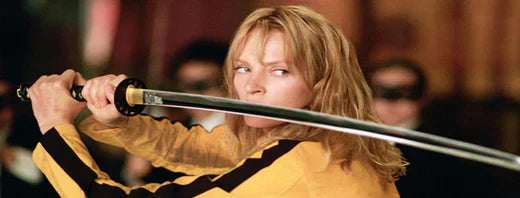
In summary:
- The "Hattori Hanzo" sword from the film Kill Bill is a cinema prop, not a historical nihonto
- The real Hattori Hanzo (1542-1596) was a samurai and ninja leader in the service of Tokugawa Ieyasu
- Replicas take their inspiration from a classic katana: carbon steel, hamon, braided tsuka
- Differences from a genuine Japanese katana: the forging, the steel and the purpose
Although the Hattori Hanzo sword is much loved by cosplayers, sword collectors and die-hard Tarantino fans, it deserves a closer look. Is it an authentic sword or a Hollywood prop? How does it compare with the legendary Japanese katana, and was Hattori Hanzo a real person?
Let's find out.
The Hattori Hanzo sword
The Hattori Hanzo sword is not a "genuine" Japanese sword, although it resembles the best-known Japanese sword, the katana. Before comparing these two swords, let's look at the features of the Hattori Hanzo sword.
Construction
In the film, the Hattori Hanzo sword is presented as a sword forged by hand by a legendary swordsmith, Hattori Hanzo. In the story, Hattori has turned his back on sword-making, opting for a more relaxed life as a head chef and owner of a sushi shop in Okinawa.
No one knows whether Hattori used Tamahagane steel to forge the Bride's sword. Katana enthusiasts who have seen the film can only assume that Hattori used a stronger steel, because this sword outperformed other swords forged by Hattori for the Deadly Viper squad.
The authentic katana is made of Tamahagane steel. Although it is not the strongest, Tamahagane IS the steel of the katana. Modern, high-grade, high-carbon steel is better, which has led viewers to believe that the Hattori sword was not made of Tamahagane.
Blade
The Bride's sword has the characteristic katana curve (Sori) of a centimetre and a half (0.6 in), measured from an imaginary line running along the back, or spine, of the single-edged sword.
Its blade (Nagasa) also shows the emblematic hardening line, or Hamon, which marks the boundary between the sharp cutting edge and the durable spine. The mirror finish is exceptional, allowing Beatrix Kiddo to see opponents creeping up behind her.
Size
Like the katana of feudal Japan, the Bride's sword measures 23.6 inches, or just over 60 centimetres, from the tip (Kissaki) to the guard (Tsuba). It is the perfect length for cutting effortlessly, as Kiddo skilfully demonstrates in the film.
Tsuka, Tsuba and Saya
The Hattori Hanzo sword has a Tsuka (handle) like the legendary Japanese katana. However, the Hollywood designers opted for a black, gold and white colour palette.
For example, a gold maple leaf adorns the Kashira and the Fuchi, while the Tsuka is wrapped in black with a complementary white ray skin. A Menuki also adds a visual element to the black wrapping of the Tsuka.
The Tsuba (guard) features the disc-shaped element of the katana, while the glossy black Saya (scabbard) is decorated with carved lions and leaves.

The Hattori Hanzo sword. Photo by Critics Rant.
Japanese katana vs the Hattori Hanzo sword
People who are unfamiliar with the Japanese katana often regard the Hattori Hanzo sword as an authentic piece. It is worth highlighting, however, the most important differences between a "genuine" Japanese katana and the Hattori sword.
Forging
Although the film shows Hattori forging the sword by hand, reproduction swords (made after the film) may take a different path. Most come from sword-making machines.
By contrast, authentic katanas can only come from a licensed Katana-kaji. It is worth noting that the katana is a Japanese national treasure and that the government wishes to preserve this rich heritage by certifying and authorising only qualified katana makers who meet strict requirements.
The steel
Another point of contention between these two swords is the steel used to make them. The Japanese government recognises only Tamahagane steel as the ingredient for making "genuine" Japanese katanas.
By contrast, Hattori Hanzo reproduction swords often have stainless steel blades, which gives the sword its characteristic shine. Some may use other metals.
Hamon
Although both the katana and the Hattori sword show a beautiful Hamon (hardening line), their creation differs.
Reproductions of the Hattori sword have acid-etched blades. Makers must chemically clean the steel blade, draw a Hamon-style pattern on photosensitive dry films and transfer the pattern to the blade using artificial UV exposure. They spray etching acid onto the blade to dissolve the exposed metal, thereby imprinting the Hamon on the Hattori Hanzo sword.
By contrast, an authentic katana must undergo clay hardening. Before heating and quenching the sword, expert katana-kaji coat the Nagasa with a special clay. Depending on the swordsmith's skill and design preferences, the Hamon can take a variety of shapes and patterns.
Strength
Clay hardening offers a further advantage to the katana. It ensures the sword's exceptional flexibility (a razor-sharp edge) and durability (a resilient spine), which gives it remarkable strength. Unsurprisingly, the katana was the samurai's favourite sword.
The Hattori Hanzo swords, however, are no stronger than the steel used to make them (although Kiddo arguably showed how effective a single stroke can be).
Purpose
Authentic katanas are genuine, tested tools. The Hattori sword is merely a prop for Hollywood actors and cosplayers.
The "real" Hattori Hanzo
Sonny Chiba's performance as Hattori Hanzo in the film is phenomenal. However, many film buffs wonder whether he is a fictional character like any other on the big screen.
No. While the Hattori Hanzo sword is as fictional as the story, Japanese history remembers a legendary figure of the same name. However, the real Hattori Hanzo was not a swordsmith. He was a formidable ninja and the leader of a group of 200 Iga ninja.
Contrary to Hollywood's portrayal of ninja as assassins, Hattori and his group helped Tokugawa Ieyasu rise to the position of shogun of a unified Japan during the Sengoku era.
Although Hattori was not a swordsmith, his sword techniques and tactics are legendary. The daimyo of the time called him Oni no Hanzo (Demon Hanzo) because of his fearless tactics.
One legend tells that Hattori refused to act as Kaishakunin for Tokugawa Nobuyasu (son of Tokugawa Ieyasu) when Nobuyasu was ordered to commit Seppuku for conspiracy and treason against Oda Nobunaga. Hattori's loyalty to the Tokugawa clan was fully on display, which endeared him even more to Ieyasu, who said with humour that "even demons shed tears".
In short
The Hattori Hanzo sword is a spectacular blade on the big screen and an excellent collector's item for cosplayers and sword enthusiasts. However, that is all it is good for. It is a fantasy piece best kept for exhibitions and performances. But if you mean the sword that the 16th-century ninja leader Hattori Hanzo wielded to keep the Tokugawa shogunate safe, that is another story.
Frequently asked questions
Did Hattori Hanzo really exist?
Yes: a samurai and ninja leader (1542-1596) in the service of Tokugawa Ieyasu, nicknamed "Oni no Hanzō", the Demon Hanzo.
Is the sword in Kill Bill a real katana?
No, it is a cinema prop. But hand-forged, film-inspired replicas do exist in carbon steel.
Who forges the swords in Kill Bill?
In the film, the fictional character of Hattori Hanzo, played by Sonny Chiba, a direct tribute to the historical figure.
Share:
Real vs Fake Katana: How to Tell the Difference
How to Display a Katana