
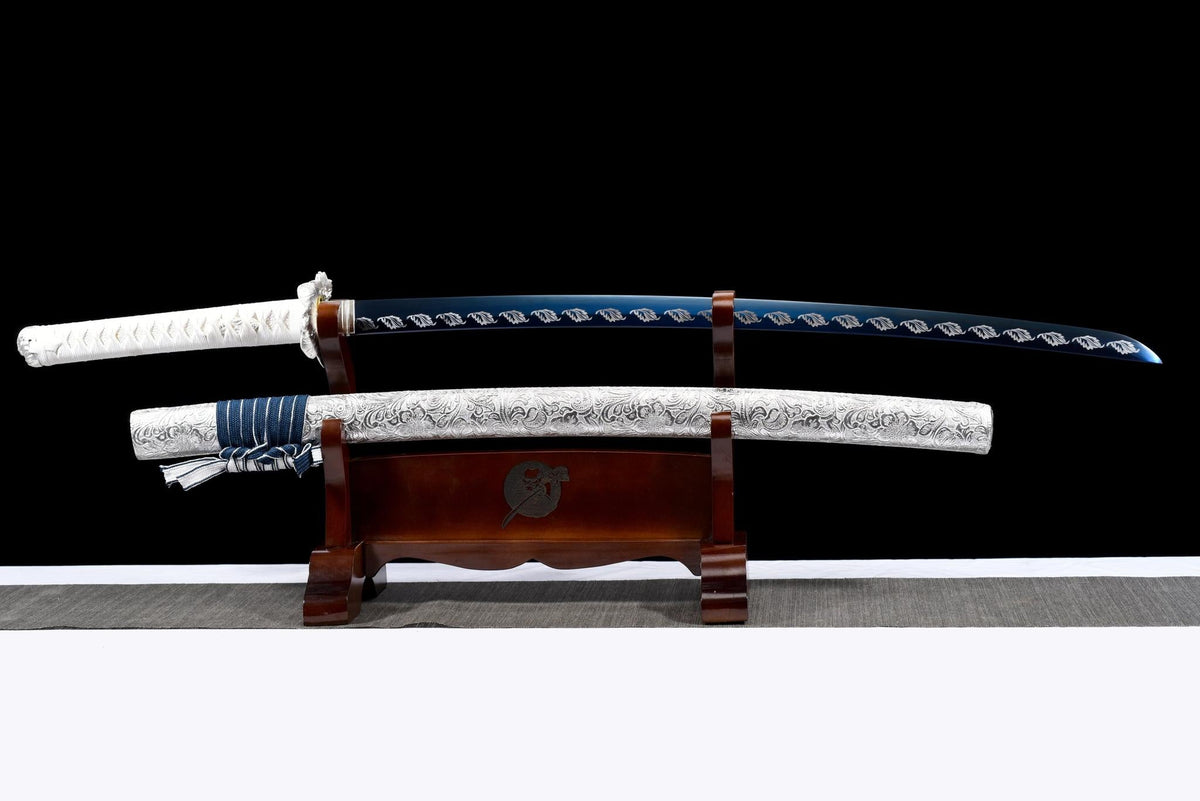
Quick summary:
- For any use beyond pure shelf decoration, yes: a stainless steel katana is a waste of money. 440 stainless is brittle at sword length and snaps cleanly rather than flexing.
- The price gap to a genuine sword is small: stainless decorations cost about £45–£130, while genuine full tang manganese and 1060 katana start at about £175.
- Stainless is defensible only for a display piece that is never touched, and even then the fittings at that price are usually glued and hollow.
- Our pick instead: the Katana Fuyu 冬, a full tang manganese steel katana from about £175, a genuine sword for the price of a decoration.
Last updated: July 2026
A stainless steel katana is a waste of money for anyone who wants a genuine sword: 440 stainless becomes brittle at katana length and snaps cleanly under flexing instead of bending. The only scenario where stainless is defensible is a pure display piece that nobody will ever handle, and even then about £45 more buys an authentic full tang carbon steel katana.
Stainless katana dominate marketplace results because they are cheap to produce, shiny in photos and never rust in a warehouse. This guide explains the metallurgy in plain language, defines the one narrow case where stainless is acceptable, and shows exactly what the next £45–£80 buys you instead.
Why is stainless steel unsuitable for a katana?
The chromium that stops rust also makes steel brittle over long lengths. A 440 stainless blade longer than 50 cm (19.7 in) cannot flex and spring back: it accumulates stress and gives way abruptly.
The metallurgy in three steps:
- Stainless means 13% chromium or more. Chromium bonds with carbon to form chromium carbides: hard, brittle microstructures spread through the steel. No problem in a kitchen knife, which is short, thick relative to its length and never absorbs an impact.
- A katana blade is a 70 cm (27.6 in) lever. Every cut, every accidental knock, every sideways oscillation multiplies the stress along the blade. Carbon steel (1060, 1095, T10) handles this by flexing and springing back straight. Stainless does not flex: it stores the stress until a zone of carbides cracks.
- The failure mode is the real problem. An overstressed carbon steel blade bends: annoying, but visible and safe. A stainless blade shatters or snaps cleanly, and the 40 cm (15.7 in) of detached blade goes wherever its momentum sends it. This is why "decorative use only" appears in small print on every honest stainless listing.
None of this is controversial among swordsmiths or practitioners. It is exactly why no maker of functional swords, at any price, builds entire blades from 440 stainless.
Is there a case where a stainless katana makes sense?
Only one narrow case: a sealed display piece that will never be handled, in a damp room, with a total budget of about £87. And even then the surrounding construction disappoints.
The honest argument for stainless is corrosion: a stainless blade on the wall needs no upkeep, ever. If that describes your situation exactly, so be it. But look at what comes with that blade at £52–£104:
- "Rat-tail" tang: a thin threaded rod spot-welded to the blade and screwed into the handle. The signature of a decoration.
- Glued or cast fittings: zinc alloy tsuba and kashira, no seppa, "ray skin" printed onto plastic.
- Cardboard-core saya: lacquered over compressed cardboard rather than wood.
- Mirror polish that hides the geometry: no shinogi line, no yokote, no true edge bevel. At arm's length, the blade reads for what it is: a prop.
A display piece also deserves to be a genuine object. That is the real case against stainless: not that it fails to cut what it was never meant to cut, but that the whole package is hollow when a real alternative costs one dinner more.
What does an extra £45–£80 actually buy?
The step from a £130 stainless decoration to a £175 carbon steel katana buys a full tang, a named steel, real fittings and a wooden saya: the difference between a prop and a sword.
| Specification | Stainless decoration (£45–£130) | Genuine entry-level katana (£175–£220) |
|---|---|---|
| Steel | 440 stainless, brittle at length | Manganese or 1060 high carbon (0.60% C), flexes and springs back |
| Tang | Welded "rat-tail" rod | Full tang, double bamboo mekugi |
| Fittings | Cast zinc, glued, plastic wrap | Iron/alloy tsuba, tsuka-ito over real same (ray skin) |
| Saya | Cardboard core | Lacquered wood |
| Can it be handled safely? | No | Yes: light cutting practice and suburi within its class |
Concrete examples at the entry level: the Katana Fuyu 冬 from about £175 (manganese steel, full tang, lacquered saya) or, for anime fans, the character-inspired replicas in 1060 high carbon steel at around the same price, such as the Giyu Tomioka-inspired katana and the Ichigo Bankai-inspired katana. One step up, the Katana Kangeki 感激 at about £250 adds clay-tempered T10 steel and an authentic hamon.
Full transparency about our own range: we do not sell stainless steel katana, precisely for the reasons in this article. Every blade in the collection names its steel. Browse by manganese, T10 or Damascus.
But doesn't carbon steel rust?
Yes, and preventing it takes about two minutes a month. A thin coat of choji oil every few weeks keeps a carbon steel blade pristine for decades.
This is the argument stainless sellers lean on, so here is its real scale. Carbon steel oxidises when moisture or finger grease is left on bare steel. Prevention: wipe the blade after any handling, oil it lightly every 2 to 4 weeks (every 2 in a humid climate), and store it in its saya. A care kit at about £25 (choji oil, rice paper, uchiko ball) lasts years. Centuries of Japanese swords have survived on exactly this routine, and so will yours. If two minutes a month sounds like too much, the answer is not stainless: it is admitting that you want a decoration, and even decorations deserve real wood and a full tang.
FAQ
Why do stainless steel katana break?
Because of chromium carbides. The 13% or more chromium that makes 440 stainless rust-resistant forms brittle carbide structures throughout the steel. On a short blade, such as a kitchen knife or an 8 cm (3.1 in) folding knife, this makes no difference. Spread over 70 cm (27.6 in) of sword blade, these brittle zones become break points. When a stainless katana meets a hard target or flexes sideways, it does not bend and return like carbon steel: it snaps cleanly. This is a physics problem, not a quality-control one, and it is why no maker of functional swords uses 440 stainless for entire blades.
Is a stainless katana acceptable for pure decoration?
Acceptable, but almost always a poor deal. A stainless katana displays well and never rusts, which sounds appealing. The problem is everything around the blade at that price: "rat-tail" tangs, glued fittings, plastic "ray skin" texture and a compressed-cardboard saya under a skin of lacquer. The sword looks fine from two metres and fake at arm's length. For about £45–£80 more, a manganese or 1060 high carbon steel katana offers a full tang, real ray skin under the wrap, a wooden saya and a blade that would actually survive handling.
How much more does a genuine carbon steel katana cost?
Typically about £45–£105 more than a stainless decoration. Marketplace stainless katana run from about £45 to £130. A genuine full tang manganese steel katana starts at about £175, and anime-inspired replicas in 1060 high carbon steel start at about the same. That small price gap is the whole argument: for roughly the price of a video game, you move from a brittle decoration to a properly constructed sword. At about £250, clay-tempered T10 with a real hamon comes within reach: a fundamentally different class of object.
How can you tell whether a katana is stainless before buying?
Read the listing, looking for four clues. One: the words "stainless steel" or "440" somewhere in the specifications. Two: no named steel at all; silence almost always means stainless. Three: the price-and-weight combination: a "katana" at £52–£104 with fast shipping and a mirror-polished blade is stainless almost every time. Four: the words "decorative" or "display only" in small print. Conversely, honest listings name the alloy (1060, 1095, T10, manganese), state "full tang" and describe the heat treatment. If those details are present, you are looking at a genuine sword.
Does a carbon steel katana rust easily?
It rusts if ignored, and stays perfect with two minutes of attention a month. Carbon steel oxidises when fingerprints, moisture or dust are left on the bare blade. The routine that prevents it completely: wipe the blade after handling, apply a thin coat of choji oil every few weeks (more often in a humid climate), and keep the sword in its saya. A care kit at about £25 covers everything you need. That is the honest bargain of owning a sword: stainless never rusts but was never a real sword; carbon steel is the genuine article.
The essentials
- Stainless steel katana are a waste of money for anyone who wants a sword: 440 stainless is brittle at blade length and gives way dangerously.
- The exception is tiny: a sealed display piece, never handled, with a strict ceiling of about £87, and even then the construction disappoints.
- About £175 buys the genuine article: a full tang manganese or 1060 high carbon katana with a wooden saya and real fittings.
- The rust "problem" of carbon steel is two minutes of oiling a month with a care kit of about £25.
Read next: T10 vs 1095 vs 1060 vs Damascus compared | Is a roughly £175 katana worth it? | How to display and care for a katana
By the Tetsuren team. Questions? Contact us directly.
Share:
Can You Get a Functional Katana for Under £350? 2026 Guide
Greatsword or Long Sword: The Grip Tells You Everything (2026)