
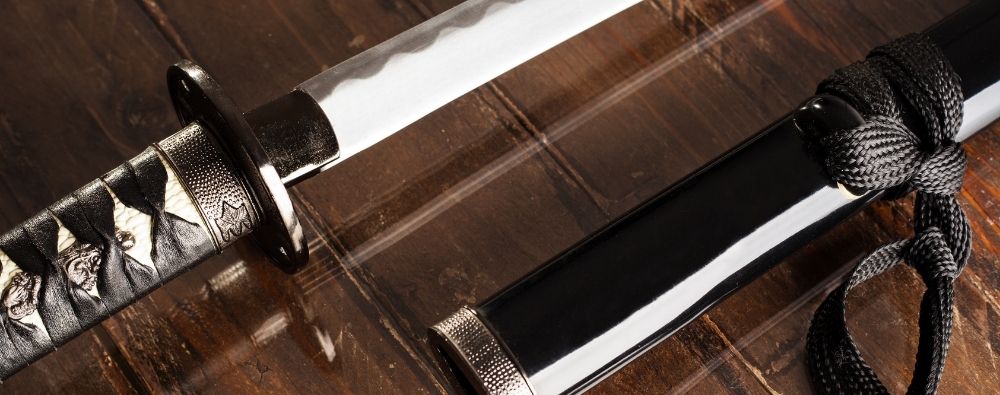
A "scabbard certificate" (saya-gaki) is an inscription on the "white scabbard" (shirasaya) in which a Japanese sword is kept and stored. The name of the swordsmith, the date of the inscription and the appraisal of the sword's value are written directly on the white scabbard, so you can tell at a glance what kind of sword lies inside. When and who first began labelling scabbards? We also present in detail the value that may interest you.
The scabbard certificate: introduction and origin

As mentioned, a scabbard certificate is an inscription written on a white scabbard. It is similar to the "hokosho" written on the box of a tea ceremony utensil. The name of the swordsmith, the length of the blade and the date of the inscription are written directly on the white scabbard in black ink.
Originally, the certificate was written by the head of a daimyo family in order to organise the swords in his storehouse. Great feudal lords owned a large number of them, including swords handed down from generation to generation as well as swords given as prizes or gifts.
To organise the swords in their collections, feudal lords began to write on a white scabbard the name of the swordsmith, the name of the maker of the fittings, the date and the name of the donor, along with other information.
Eventually, samurai society collapsed. Over time, the scabbard inscription was replaced by a "certificate of authenticity", and the person writing it was no longer a feudal lord but a "connoisseur".
What is a white scabbard?
The white scabbard is a wooden sheath intended to keep and store the blade of a Japanese katana. The katanas you often see are mounted in a koshirae, which is decorated with lacquer and other materials.
Although these koshirae are beautiful and can be used straight away, leaving the sword in the koshirae will allow it to rust easily because of the lack of ventilation. Therefore, when it is not in use, it should be stored for the long term in a well-ventilated white scabbard. For this reason, the white scabbard is also known as a "resting scabbard".

The material used for these white scabbards is magnolia (Magnoliaceae). This wood is characterised by its dense, even and soft texture, which makes it easy to work. Besides white scabbards, it is also used for shogi pieces (Japanese chess) and piano keys. In particular, in its solid untreated white-wood state, magnolia is sensitive to humidity and has excellent absorbency. Because its moisture level stays stable, it resists rust, making it an ideal material for preservation.
An important extra tip: if you keep the white scabbard in a katana bukuro (sword bag) in a place out of direct sunlight, it will block the light and stabilise the temperature, preventing rust caused by condensation.
It is recommended to order a made-to-measure white scabbard that fits your Japanese sword perfectly. Prices start at around 20,000 yen. A high-quality white scabbard is expected to last more than 50 years.
Who writes the certification, and where?

The appraisers who write on the scabbard are mainly descendants of Hon'ami Mitsunori, a sword appraiser who was authorised by Toyotomi Hideyoshi. He was authorised to issue "origami" certificates, in the same way as during the Edo period.
During the period of upheaval that followed the fall of the Edo shogunate, scabbard inscriptions were frequently applied during the Meiji period (1868–1912) in order to guarantee authenticity. The name of the maker (zeimei), the length of the blade and the date of the scabbard inscription were written on the white scabbard.
The scabbard inscription is meant to be placed on the surface of the blade, as on a tachi. Since there are many cases, such as short swords, where it is not possible to write all the information on one side, the name (or "kakume") and the length of the blade are written on the front of the scabbard, while the date of inscription and the name of the person who wrote it (hanasho) are written separately on the back of the scabbard.
Besides the descendants of the Hon'ami family, other famous people have written scabbard inscriptions, including Takase Hazatsu, Sato Kan'ichi (also known as Sato Kanzan) and Honma Junji (also known as Honma Kunzan).
Famous sword appraisers
Hon'ami Nisshu
1908 – 1996.
He studied under Hon'ami Rimga, a branch of the Hon'ami family, and was adopted at the age of 19. He learned polishing and the appraisal of Japanese swords, and became a holder of the technique of an Important Intangible Cultural Property (Living National Treasure) in 1975. His son Honami Koshu was also designated a Living National Treasure in 2014.
Takase Uko
1853 – 1924
Journalist and sword researcher. He published the "Tohoku Mainichi Shinbun" and campaigned for liberal civil rights. He was secretary of the sword society of the Yasukuni Shrine Yushukan. Author of "Detailed Book on Swords" and "History of Swords".
Sato Kan'ichi / Kanzan
1907 – 1978
Sword specialist. Executive director of the Society for the Preservation of Japanese Art Swords. Deputy director of the Sword Museum. He was regarded as an authority on the appraisal of Japanese swords, notably in the study of new swords.
Honma Junji / Kunzan
1904 – 1991
Researcher of Japanese swords. He founded the Association for the Preservation of Japanese Art Swords, of which he was director and president. He is an authority on the appraisal of Japanese swords, particularly in the study of antique swords. Author of "Japanese Swords" and "History of Japanese Swords".
Is a katana worth more with a scabbard certificate?

The "certificate of authenticity" (formerly the "certificate of approval") and the "certificate of designation" are issued by appraisal bodies such as the Society for the Preservation of Japanese Art Swords and are used to guarantee the value of a Japanese sword.
Scabbard certificates, by contrast, are often made by private appraisers. The most reliable guarantee is a certificate of authenticity (formerly a certificate of recognition) or a certificate of designation issued by the Society for the Preservation of Japanese Art Swords.
With a certificate of authenticity, the value of the katana will not change even if there is no scabbard certificate. However, in these uncertain times, many people want something a little more tangible and reliable.
As a result, a katana with a scabbard certificate seems more trustworthy and often reaches a higher price on the market. The standing of the person who writes the scabbard certificate is also a factor that makes it trustworthy.
However, it can be misused. Counterfeit Japanese katanas, including the sword itself and even the scabbard, can be put into circulation, and there is a risk of secondary or tertiary damage.
Share:
What Is Bushido? The Samurai Code of Honour Explained
What Is a Nagamaki?